2026 Edition · Text current as of 4 August 2026 · Desktop scouting workbook included, no extra cost
It usually isn't luck, and it usually isn't the site. Nobody ever taught you how to read the ground before you park. Ninety-six numbered field entries that fix that, starting with next Saturday.
No coordinates. No site list. No claim that anybody here has stood on your ground.


The Rockhound's Compass — the complete field system
Those three are sections of one 319-page PDF, not three separate files. The prices beside them are what each is worth on its own; you pay once.
$41$24 — everything, one PDF
Secure Stripe checkout · Instant PDF delivery to your email · 60-day refund, and you keep the PDF
Three things this book refuses to do. Each one is a decision, not an omission, and each one is the reason it will still be useful in 2030.
Every site printed in every guidebook on your shelf sits inside a mapped rock unit. That unit does not stop at the pull-out where somebody could park — it outcrops across far more ground than that, often hundreds of square miles, and nobody has walked all of it. The state geologic map that shows you the rest of it costs nothing. This book teaches you to find the rest.
There is no résumé on this page because there is no résumé to print. Every fact in the book is attributed to a source you can reach for free — the Handbook of Mineralogy, hosted free by the Mineralogical Society of America; the Code of Federal Regulations by section; USGS, BLM, NPS — and Appendix C lists every one of them with the date we checked it, closing with a printed list of what we could not verify.
A pull-out gets posted, claimed, bought or picked clean, and the book that sent you there has no way to tell you. A lava-flow contact does not move. Neither does the fact that agate has no density for a river to sort by.
Secure Stripe checkout · Instant PDF delivery to your email · 60-day refund, and you keep the PDF
You're doing the obvious things right. So why does the bucket keep coming home full of gravel?
You dug all day at the site everyone digs — in the hole beside the hole beside the hole — and what was at the bottom had been dropped there by somebody else. It isn't bad luck. It's arithmetic: a site is famous because you can park at it, so everyone works the same twenty yards.
→ Chapter 11 · Picked-Over Ground: Working a Site a Hundred People Have Already Worked
Two hours out on a published point, and you arrive at a fence, a posted sign, or the wrong half of the state — and the book that put you there is the one you paid for. Guidebook sites have been documented, in the reviews of those guidebooks, as landing on private ground. You have no way to check them, so you stop trusting all of it.
→ Chapter 1 · Six Tests for a Rockhounding Source, and This Book Under All Six · Chapter 12 · Whose Dirt Is This
You asked where, and you got silence, or you got told. It is the most resented sentence in this hobby — and it is, annoyingly, the correct instruction. It is useless only because almost nobody attaches a procedure to it, and a procedure can be written down and handed to a stranger.
→ Chapter 2 · Nobody Has to Hand You Coordinates
There is a bag in the garage with exactly that written on it in marker. You have been picking rocks up for decades and you still cannot name most of them, and nobody ever showed you the words — waxy, greasy, vitreous, conchoidal — as anything other than definitions.
→ Chapter 9 · Reading It Wet · Chapter 10 · Before You Cut It
Every guide identifies agate by its banding. The banding is inside the rock. You are standing in a creek with a wet, dirty cobble in your hand and no way to decide, and nobody is cutting cobbles in half on a gravel bar.
→ Chapter 10 · Before You Cut It — What an Agate Looks Like From the Outside, Still Dirty
BLM, Forest Service, Wilderness, Monument, Park, state land, somebody's claim, somebody's ranch. The people explaining it online correct each other in the comments, and the ones doing the correcting are not sure either. Mineral trespass is not a parking ticket.
→ Chapter 12 · Whose Dirt Is This — BLM, Forest Service, Park, Monument, State Land, Somebody's Claim, Somebody's Ranch
Learning what agate is takes an afternoon. Learning where to stand is the whole hobby.
Secure Stripe checkout · Instant PDF delivery to your email · 60-day refund, and you keep the PDF
Every entry has a name as well as a number, because a named procedure is the thing you repeat to somebody at a tailgate. Every chapter opens with what it decides, carries a Different rock, different rules box keyed to what is under your boots, names its own failure mode in a section called How this fails, and closes with Check me — the sources behind it, by name and by the date we checked them.
The physics correction the whole shelf gets wrong. Agate has a specific gravity of about 2.6 — the same as every other pebble in the bar — so the river does not sort it. It destroys everything softer around it instead, which means you read gravel composition, not gravel position, and the productive window sits well downstream of the source. Then the other half: garnet, sapphire, zircon and cassiterite genuinely do sort by density, and for those the crevice-and-inside-bend playbook is exactly right. Two targets, two physics, two search patterns, and you decide which one you are running before you step onto the gravel.
Twelve numbered entries, four questions in a fixed order, every rule with its section number and the date we checked it — including the one figure everybody quotes and almost nobody attributes correctly. Utah, Arizona, Texas and Oregon worked as examples of how differently four states behave.
Eleven field tests you can settle in under a minute per rock, with a free quartz pebble as the only hardness anchor you can trust at exactly 7 — and the most-printed hardness test in the hobby, which stopped working in 1982 and which you can disprove on a kitchen scale.
Appendix A · The One-Minute Field Key — Chapter 9 compressed to the length you can read with a wet rock in the other hand, in the order the tests are worth running.
Appendix B · Going Out at Sixty-Five, and Going Out Alone — clubs and field trips, what a day actually weighs, how to do the field parts with less crouching, and an honest section for the reader who follows this hobby without being able to get out at all.
Appendix C · Check Me — The Words, the Sources, and the Free Tools — the vocabulary, every source behind every number with the address to go and check it, and the list of what we could not verify.
A real index, built on the words you look up with the stone in your hand — amygdale, cleavage, float, leaverite, MTRS, overburden, patented, rind, streak, thunderegg, vug.
Secure Stripe checkout · Instant PDF delivery to your email · 60-day refund, and you keep the PDF
Included · No extra cost
The book teaches you to read ground. The workbook is where you do it — on your county, with your map, and the output is your shortlist, not ours.
Eleven worksheets, thirty-seven pages inside the file, with its own cover. You work them at a kitchen table with a pencil before you spend a dollar: what has already been reported here → find the rock unit, which is the whole point → your lithology sheet → everywhere else that unit outcrops → who manages the surface and what that office says → turn your pin into Meridian, Township, Range and Section → is it claimed → can you get to it, and where does water cut it → the phone call, scripted → rank them, then go → the next four counties.
It opens by running the entire method on one real county in public, printing what each free tool actually returned. That county was chosen by arithmetic for having nothing reported in it, we have never set foot in it, and the run ends the way an honest desktop run ends — with questions for an office, not with a place to go.
"There's nothing in my state" is almost always a search problem, not a geology problem.
Secure Stripe checkout · Instant PDF delivery to your email · 60-day refund, and you keep the PDF
Included · No extra cost
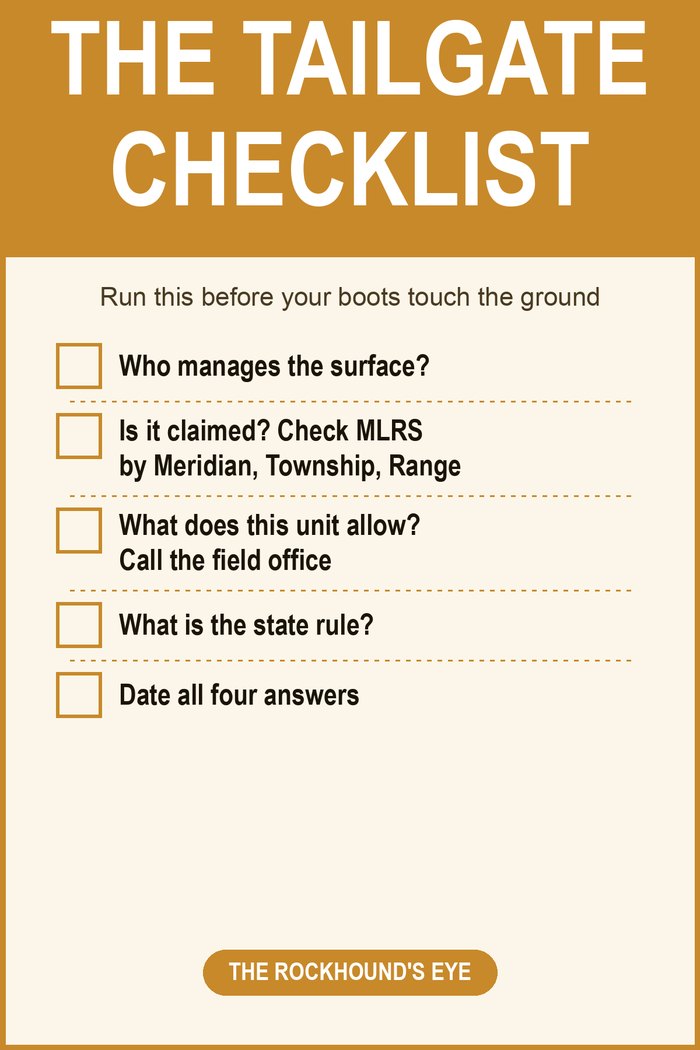
Print it black-ink and fold it into the glovebox, with the notices travelling on the reverse. It is the sequence you run the night before you leave and again before you swing anything: pin the ground, name the agency, run the claim check, make the call, date all four answers — then the loading list, the tailgate check, the tests in order, what you may carry out, and what you do before you drive away.
It ends in a go / no-go list. Any single no and you do not dig. Two of those lines decide whether you are allowed to be standing there at all.
Secure Stripe checkout · Instant PDF delivery to your email · 60-day refund, and you keep the PDF
| The Rockhound's Compass | 13 chapters · 96 numbered field entries · three appendices and a real index | $29 |
| Your County, Not Mine | The desktop scouting workbook · its own cover · 11 worksheets, thirty-seven pages · your county, your shortlist | $9 |
| The Tailgate Checklist | Print it black-ink and fold it into the glovebox · the pre-drive and pre-dig sequence, ending in the go / no-go line, with the notices on the reverse | $3 |
| Total | $41 | |
| Today | $24 — everything, one PDF |
Every number in that column is a real price of a real product, checked on 4 August 2026 — not a figure invented to discount from. $29 is the ceiling of premium print in this category: a 44-page laminated field guide sells for $29.95, and a 150-page rockhounding guide for $29.97. $9 is the middle of the pocket-material band, $4.74 to $12.95. $41 is the observed hardcover ceiling of this niche, $39.13 to $40.58. We are not going to strike through a number nobody ever paid.
At $24 this costs less than the laminated 44-page card set on the same shelf, and less than a single year of the public-land mapping subscription you were about to buy — which is $34.99 a year, every year.
Secure Stripe checkout · Instant PDF delivery to your email · 60-day refund, and you keep the PDF
There is no author photograph on this page and no list of years in the field, because there is nothing honest to put there. What there is instead is this.
The edition carries its revision date on the cover — 4 August 2026 — and when the rules move, the edition moves. We would rather be caught than trusted.
Secure Stripe checkout · Instant PDF delivery to your email · 60-day refund, and you keep the PDF
One PDF, 319 pages, delivered to your email immediately after checkout. That single file contains the book, the 11-worksheet scouting workbook with its own cover, the printable tailgate checklist, three appendices and a real index. Three named pieces, one file in your inbox — we would rather say that plainly here than have you count the attachments and wonder. If you add the Field Card Deck at checkout, it arrives as a second file in the same email: twelve cards, nineteen pages.
No, and that is the point rather than a gap. It teaches you to work out where to go, in your own county, from free public maps and free federal data. Every published coordinate you can buy today is already being driven to by everyone else who bought that book, and some of those coordinates land on private property. The ground you work out for yourself is not on anybody's list.
Keep watching — that is where you see the thing, and seeing it is the part a page cannot do for you. What a video cannot do is stand at your tailgate, in your county, on a Tuesday night, while you work out whether that outcrop is worth a tank of fuel and whether you are allowed to pick anything up when you get there. That is a procedure you run, not a thing you watch. And Chapter 1 gives you six named tests for judging any source in this hobby — a book, a video, an app, a forum post — with this book run through all six in the same chapter, so you can grade us with the same tool.
Three things you can check before you decide. What a river actually does to agate, as opposed to what placer logic borrowed from gold prospecting says it does. Where the 25-pounds-a-day figure is really codified, and why that matters. And why the penny test stopped working in 1982, which you can settle on a kitchen scale. If all three are already familiar to you, ask for the refund and keep the file.
It is built on rock types rather than on places, so it works wherever those rocks are, which is everywhere. The legal chapter covers the federal agencies in full and then works Utah, Arizona, Texas and Oregon as examples of how incompatible four state regimes can be — one sells a permit with poundage limits, its neighbour offers no collecting permit at all, and you can cross between them on a county road without seeing a sign.
This book does not value specimens and does not tell you what anything is worth. It is about finding material and identifying it in the field. Where it talks about quality, it means translucency, pattern, integrity and size — not price. If you want a valuation, take the specimen to a qualified appraiser.
Less than you think, and the book says so before it recommends anything. The most useful hardness reference in it is a quartz pebble, which is free and is exactly 7. Chapter 13 closes with a list of five things not to spend your money on, including one popular light that is a different product from the one people think they are buying.
The Rockhound's Compass is written from published sources rather than from anyone's personal field record, with AI assistance, and every source is named in Appendix C along with what we could not verify. That is the whole claim, and it is the reason the book names no site it has not been to. As for going stale: the geology will not. The legal chapter carries the date it was checked and the section number for every rule, so you can re-check any of it in a minute, and the edition is dated on the cover so you always know what you are holding.
The Own Ground Guarantee. Read the book. Run the workbook on your own county. If you can't stand at your tailgate and say why this ground and not that ground — and whether you're allowed to pick anything up — email us within 60 days at the address on your receipt and we'll refund every cent. No forms, no questions, no hard feelings. You keep the PDF.
Secure Stripe checkout · Instant PDF delivery to your email · 60-day refund, and you keep the PDF
The ground in your own county has been sitting under a free map this whole time. What you have been missing is the procedure for reading it, and the four questions that tell you whether you may pick anything up when you get there.
$41$24 — everything, one PDF
Secure Stripe checkout · Instant PDF delivery to your email · 60-day refund, and you keep the PDF
Free · 19 pages · No cost, no card
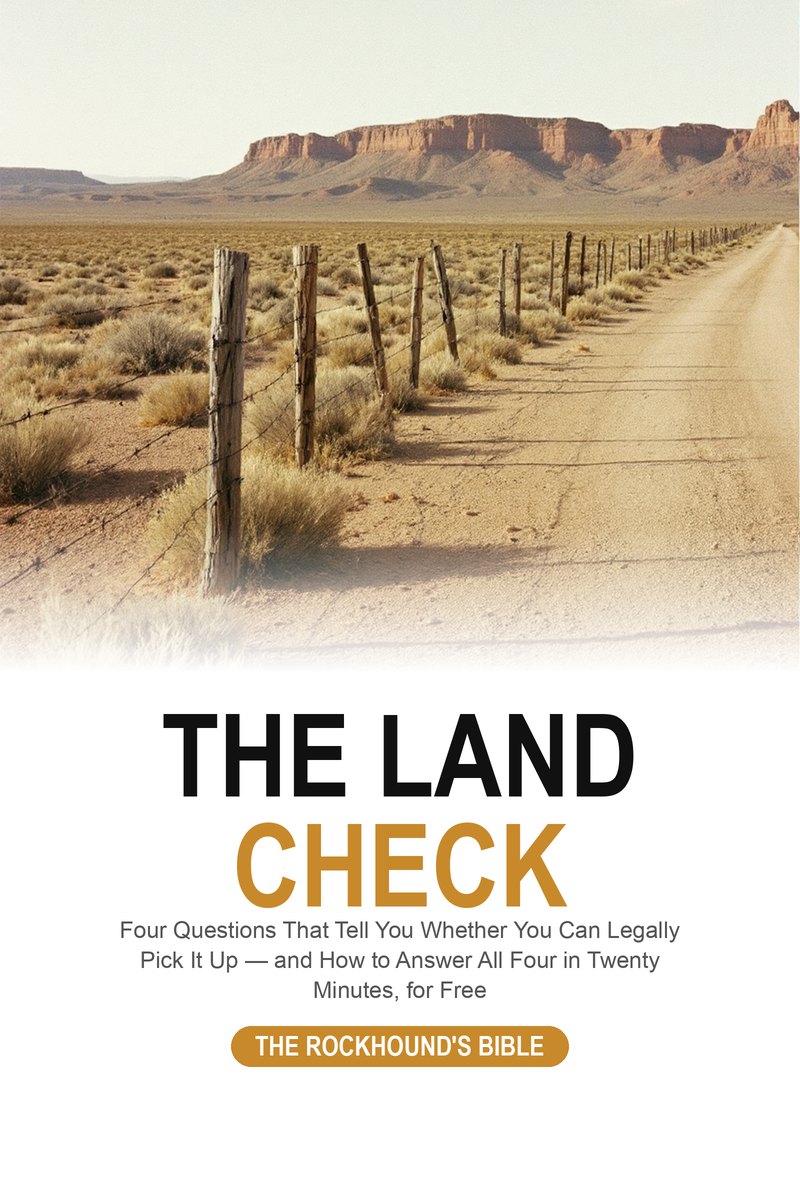
Four questions that tell you whether you can legally pick it up — and how to answer all four in twenty minutes, for free.
Who manages that surface. Whether an active mining claim sits on it. What that specific unit's own rule says. And what the state says, because state land is not federal land and the federal rules do not apply to it.
Nineteen pages, step by step at the kitchen table, with the free federal tools named by the task rather than by the button — because agencies redesign viewers faster than they change regulations — and the Step 0 skill that makes the claim search work, turning a pin on a map into Meridian, Township, Range and Section, which is what the search actually eats. Every regulation in it carries the date it was checked and the reference you need to check it yourself.
It will not tell you where to go. It tells you whether you are allowed to be there, which is the question nobody in this hobby answers for free.
No cost, no card. One email with the PDF, then three short ones over the following nine days — the ground people actually dig, one entry from the book you can check on a kitchen scale, and a plain account of who the book is not for. Unsubscribe in one click.
Free · 19 pages · No cost, no card
Four questions that tell you whether you can legally pick it up — and how to answer all four in twenty minutes, for free.
Who manages that surface. Whether an active mining claim sits on it. What that specific unit's own rule says. And what the state says, because state land is not federal land and the federal rules do not apply to it.
It will not tell you where to go. It tells you whether you are allowed to be there, which is the question nobody in this hobby answers for free.
No cost, no card. One email with the PDF, then three short ones over the following nine days — the ground people actually dig, one entry from the book you can check on a kitchen scale, and a plain account of who the book is not for. Unsubscribe in one click.